
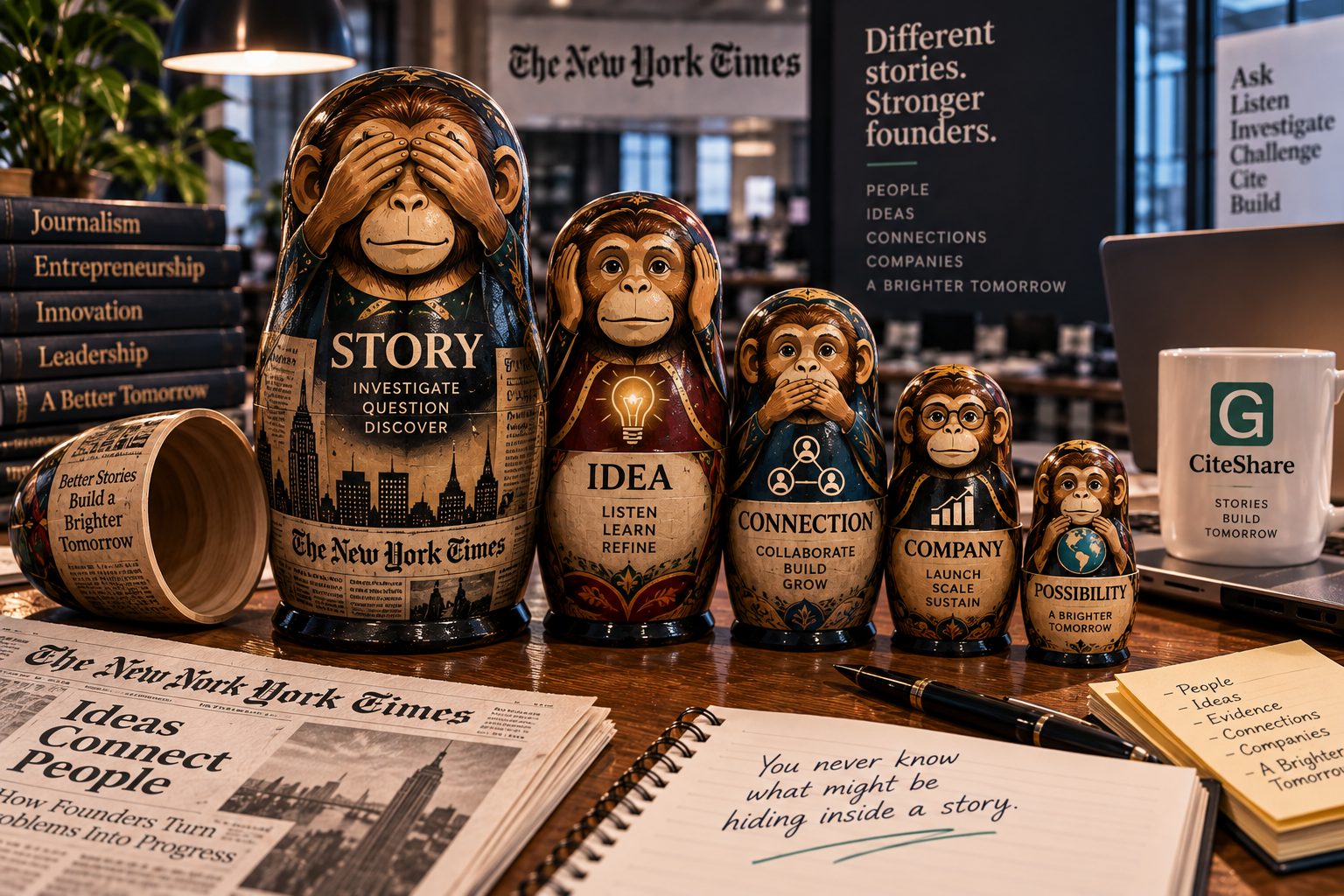
STORYTELLING SERENDIPITY™
The story comes first.
There is an almost sacred rule inside a great newsroom:
The story comes first.
Businesses are living stories.
They have characters, conflicts, evidence, unanswered questions, reversals and discoveries. Customers change them. Competitors challenge them. New information forces them to rewrite what they thought they knew. The story is never truly finished as long as the company is alive.
That's why CiteShare thinks of itself as a newsroom for startups.
In a newsroom, content may fill the pages, but the story is master. Everything—reporting, interviewing, evidence, editing, photography, data and design—ultimately serves the story.
At CiteShare, the founder serves the story the same way: question it, investigate it, challenge it, strengthen it—and keep rewriting it as the evidence changes.
Better storytellers become better thinkers. Better thinkers can become better founders.
CiteShare brings that same discipline to entrepreneurship. The product, technology, research, customer evidence, team and capital should ultimately help a founder answer one question:
What is the story we're trying to make true?
Reporters may disagree. Editors challenge assumptions. Sources contradict one another. New evidence can destroy yesterday's theory. Drafts are rewritten. Ledes disappear. Entire sections get cut.
But everyone is ultimately serving the same thing:
Make the story better. Make it clearer. Make it accurate. Find what is missing.
The newsroom has a nearly laser-like focus on shaping the story until it can survive the questions that will be asked of it.
CiteShare believes entrepreneurs can learn something profound from that discipline.
Because before a company becomes a product, an organization, a brand or a balance sheet, someone has to make sense of a problem well enough to tell its story.
And telling that story well requires thinking well.
BETTER STORYTELLERS BECOME BETTER THINKERS.
A founder who cannot explain the problem may not understand the problem.
A founder who cannot explain why the customer should care may not understand the customer.
A founder who cannot defend an assumption may need evidence.
A founder who cannot answer a question may have just discovered the next thing that needs to be investigated.
That's why CiteShare doesn't treat storytelling as decoration added to a company after it has been created.
The newsroom taught us that stories get stronger when other minds encounter them. The incubator taught us that companies do too.
Storytelling is part of how the company gets created.
FROM THE NEWSROOM TO THE INCUBATOR
What if founders worked on their Business Pitches the way reporters work on stories?
A reporter rarely produces a great story by sitting alone and protecting the original idea.
The reporter goes out into the world.
Ask. Listen. Investigate. Challenge. Verify. Cite. Rewrite.
Then the story enters the newsroom.
Other people touch it.
An editor asks the question the reporter missed. Another reporter remembers a source. A researcher finds contradictory evidence. A photographer sees something differently. The copy desk spots an inconsistency.
The original story gets better because other minds encounter it.
We believe the same thing can happen to businesses.
That's why CiteShare wants founders telling their developing Business Pitches to one another, not merely presenting finished pitch decks to investors.
When founders tell stories together, they don't simply become better presenters.
They can become better thinkers—and therefore better founders.
THE NEWSROOM AND THE INCUBATOR HAVE SOMETHING IN COMMON
At first, they seem like completely different places.
One produces stories.
The other produces companies.
But both create something extraordinarily valuable:
PROXIMITY BETWEEN CURIOUS PEOPLE WORKING ON UNFINISHED THINGS.
Newsrooms place reporters, editors, researchers, photographers and specialists near one another.
Incubators place founders, mentors, investors, technologists and developing companies near one another.
And proximity produces things that cannot always be scheduled.
Someone overhears a conversation.
A founder recognizes another founder's problem.
An editor remembers a source.
A mentor notices two companies serving the same market.
One entrepreneur's discarded approach becomes another entrepreneur's solution.
Two people who arrived intending to build separate companies discover they should be working together.
The environment begins contributing to the work.
That's where CiteShare moves from storytelling into Storytelling Serendipity™.
STORYTELLING SERENDIPITY™
The unexpected discovery of an idea, piece of evidence, person or connection that makes a story better—or makes an entirely new story possible.
A newsroom cannot command a reporter to have an unexpected discovery at 2:15 Tuesday afternoon.
An incubator cannot schedule the conversation that unexpectedly produces a partnership.
And CiteShare cannot manufacture serendipity.
But we can create the conditions that make it more likely.
That is why we bring Business Pitches, founders, experts, customers, evidence and other companies into the same environment.
Because every additional story creates another possibility for connection.
And sometimes something even more interesting happens.
One story contains another story.
IDEAS CAN CONTAIN OTHER IDEAS
Like Russian nesting dolls, sometimes you don't know what's inside an idea until you open it.
From there, Planetary Swarm → Construto-Bots → AWF becomes our concrete example.
And then the page continues through the backbone we established:
STORYTELLING SERENDIPITY™
The newsroom philosophy — make the story stronger through discovery.
↓
SOCIAL INCUBATION
The environment — put developing founders, stories and companies in proximity.
↓
SERENDIPITY ENGINE
The technology — actively identify useful intersections among people, needs, knowledge and companies.
↓
COLLECTIVE COMPANY CREATION
The outcome — stronger companies created with more collective intelligence.
The newsroom taught us that stories get stronger when other minds encounter them. The incubator taught us that companies do too.
BETTER STORY → BETTER THINKING → BETTER FOUNDER → BETTER COMPANY
BETTER STORIES + MORE MINDS + MORE PROXIMITY → UNEXPECTED CONNECTIONS → BETTER COMPANIES