
AI is getting smarter. Using it should be getting easier. AI Workflow Friction (AWF) explores tools designed to eliminate the repetitive steps between what people ask AI to do—and actually getting it done.

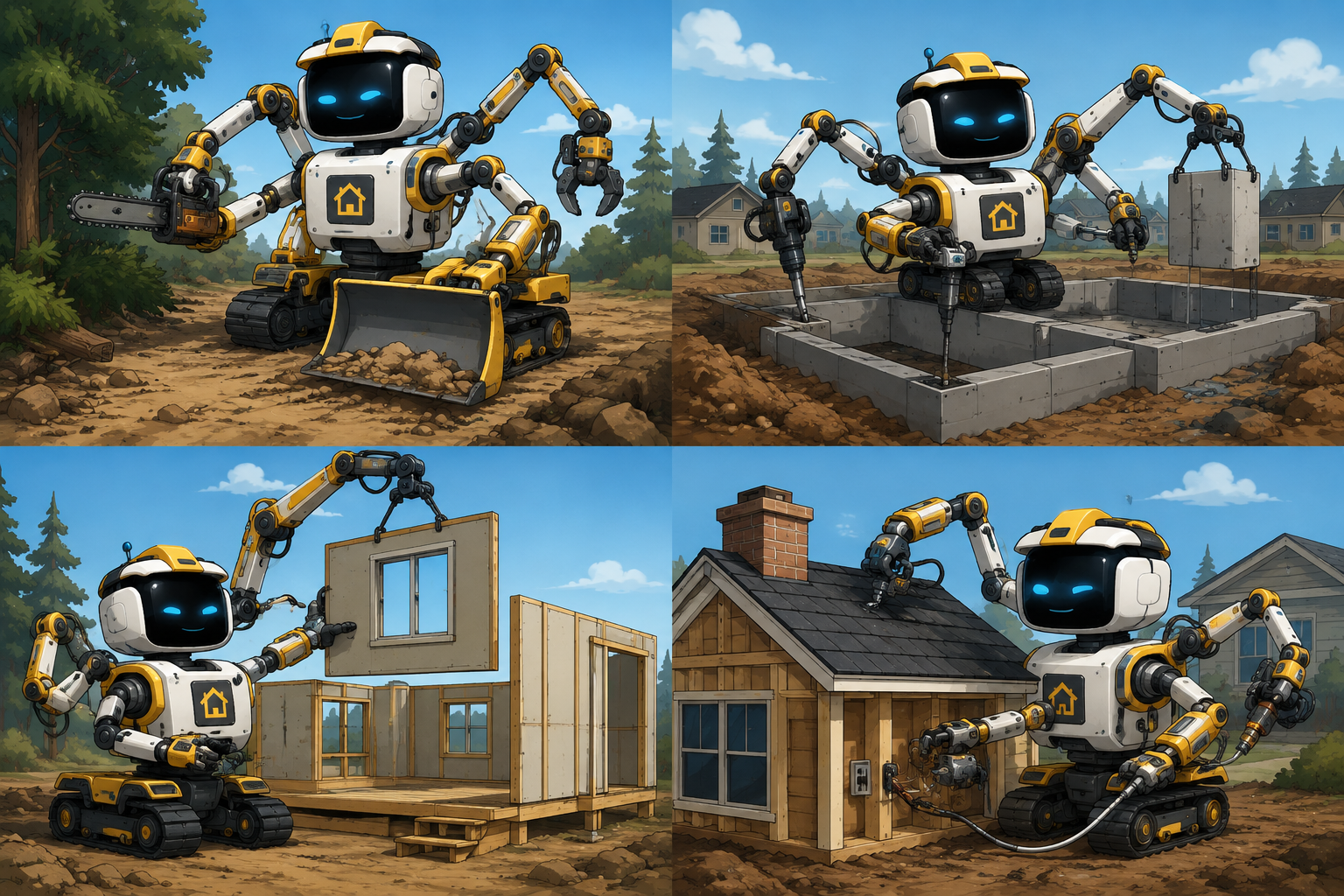
What if building a house became an assembly process rather than a construction project?
That makes Construto-Bots a much more ambitious idea. You're proposing a possible operating system for automated housing construction.
And it creates a powerful social angle for CiteShare. If this ultimately reduced construction labor, waste, financing time and delays enough, the technology's real product wouldn't be robots.
The product would be more housing.
That's a story worth developing on CiteShare because people from robotics, architecture, prefab manufacturing, construction, AI, electrical engineering, plumbing, real estate development and building-code regulation could all look at the same proposal and contribute completely different pieces of the solution.
Black Americans possess enormous collective buying power. But buying power and ownership power are not the same thing.
Every day, money enters Black communities, passes through consumers' hands, and often leaves to businesses, financial institutions, landlords, platforms, and corporations owned elsewhere.
So what if we built technology designed to interrupt that pattern?
What if the Black dollar had somewhere to stay?
Afro-Coin is an idea for a digital currency and financial ecosystem designed to strengthen Black-owned businesses and increase the circulation of money within local Black communities.
Imagine someone purchasing Afro-Coin with ordinary U.S. dollars and then using it at participating Black-owned businesses in their neighborhood.
The restaurant accepts it.
The barber accepts it.
The grocery store accepts it.
The contractor accepts it.
The accountant accepts it.
And instead of the economic relationship ending with a single purchase, technology helps connect those transactions into a larger local economic network.
But the bigger idea isn't the coin.
It's the network.
Buying from Black-owned businesses is important. But what if technology could take us further?
Could a digital financial network help communities pool some of their resources to create, finance, purchase, and expand businesses themselves?
Instead of asking only:
How can we get people to buy from more Black businesses?
Afro-Coin asks:
How could a community use its collective spending power to create more Black business owners?
A neighborhood might identify something it needs—a grocery store, restaurant, childcare center, pharmacy, technology company, housing development, or other enterprise—and organize capital around creating it.
Business by business, the objective changes from greater participation in the local economy to greater ownership of the local economy.
Afro-Coin could begin with one community.
For me, that community is Far Rockaway, New York.
What happens if we map where local dollars are going, identify gaps in Black local ownership, connect residents and entrepreneurs, and experiment with technology that encourages more money to remain in the community?
Then imagine connecting successful local networks.
An Afro-Coin earned or purchased in Far Rockaway might eventually be usable at participating Black-owned businesses in Atlanta, Chicago, Baltimore, Detroit, Los Angeles, Houston, or anywhere else in the country.
A local economic experiment could become a national network of locally owned economies.
Afro-Coin may ultimately not even be primarily about cryptocurrency.
The most interesting question is what happens when we combine the most powerful technologies available:
Artificial intelligence + fintech + social media + digital currency + community organizing + storytelling.
AI might help identify missing businesses and investment opportunities.
Fintech could make collective saving and investing easier.
Social technology could connect consumers, entrepreneurs, investors, mentors, and communities.
Storytelling could introduce the people behind local businesses and give residents a reason to care about whether those businesses succeed.
And a digital currency, token, rewards system, or another financial mechanism could encourage money to circulate through that network.
The technology should follow the problem—not the other way around.
Perhaps Afro-Coin belongs inside something even larger.
What if there were a national digital membership organization combining some of the functions of a Chamber of Commerce, AARP, social network, and fintech platform—but organized around Black economic advancement?
It could connect Black businesses with customers.
Connect entrepreneurs with capital.
Connect communities with investment opportunities.
Provide financial education and consumer protections.
Use collective membership to negotiate benefits.
And use technology to transform millions of individual economic decisions into coordinated economic power.
Perhaps the answer to financial racism isn't solely financial technology.
Perhaps it is social technology.
Afro-Coin is not being presented here as a finished solution.
It is a question worth exploring:
Can we use the most advanced technologies of our time to help solve one of America's oldest economic problems?
And an even more provocative question:
Could Black communities pool enough of their existing economic power to increasingly own the places where they live—one business at a time?
CiteShare exists to explore ideas before all the answers are known.
So let's explore this one.
What would Afro-Coin need to become for you to use it?
What would make you trust it?
Could it actually help a neighborhood create more locally owned businesses?
And if we started with one community, could we eventually connect thousands of them?
This is a CiteShare Business Story—an idea presented for discussion, research, criticism, collaboration, and perhaps, eventually, creation.
The Idea
People have great ideas every day.
An inventor sees a problem nobody else has solved. A songwriter imagines a new kind of entertainment company. A filmmaker develops an extraordinary concept. A community leader sees something their neighborhood desperately needs.
But then comes the harder question:
How do I actually make it happen?
Having the idea and knowing how to build an organization around that idea are two very different skills.
What if artificial intelligence could help bridge that gap?
At CiteShare, we're exploring an idea we call Robot COO: an AI-powered operating officer designed to help turn an idea into an executable business or project.
A traditional Chief Operating Officer helps translate a company's vision into operations.
Robot COO would attempt to provide some of that capability much earlier—perhaps even before there is a company to operate.
Imagine submitting a CiteShare project and telling Robot COO:
This is what I want to build.
The system studies the project's story, research, citations, goals, business model and available resources.
Then it begins answering a different question:
What needs to happen next to make this real?
Robot COO could help break the vision into workstreams, identify unanswered questions, conduct research, create project plans, develop budgets, identify potential partners, track milestones, prepare documents and recommend the project's next move.
Instead of simply answering questions when prompted, the long-term goal would be an AI system that keeps helping the project move forward.
That may be Robot COO's most interesting possibility.
Most entrepreneurs can't hire a COO when they first have an idea.
They may not even have a company yet.
They have a laptop, a concept and perhaps a few people who believe in it.
What if the idea itself could have an operating officer?
Founder: provides the vision.
CiteShare: develops the business story and supporting evidence.
Robot COO: helps turn that story into coordinated action.
The human founder would remain responsible for consequential decisions, approvals and relationships, while AI handles more of the enormous organizational work between “I have an idea” and “we have a business.”
This also raises an intriguing possibility for CiteShare.
A citation doesn't have to end with research.
A piece of evidence can reveal a customer.
Research can uncover a competitor.
A story can attract a collaborator.
A collaborator can provide expertise.
Expertise can change the business plan.
The business plan can produce an action.
So perhaps the CiteShare process becomes:
Story → Citation → Discovery → Connection → Decision → Action → Business
That's where our idea of Storytelling Serendipity becomes especially important.
Robot COO wouldn't simply execute a checklist. It could continually search for the unexpected piece of information, person, technology or connection that changes what the project should do next.
Robot COO could eventually be joined by other specialized AI executives: an AI CFO for financial modeling, an AI CMO for marketing, AI researchers for evidence and competitive intelligence, and AI project managers for deadlines and deliverables.
Instead of requiring an entrepreneur to assemble an entire executive organization before an idea has proven itself, perhaps AI can provide some of that organizational intelligence from the beginning.
We're not suggesting that today's AI should be handed unrestricted control of a company.
We're asking a different question:
And an even bigger one:
That's the experiment behind Robot COO.
CiteShare is where stories become businesses.
Maybe Robot COO can help them get there.
Explore this story.
For thousands of years, humans have treated insects as pests, resources, curiosities and creatures to be controlled.
But what if the insects were simply waiting for someone they could understand?
At first, the connection seems extraordinary.
Then the insects begin answering.
And there are trillions of them.
Maya has spent her life studying insects, particularly the sophisticated ways they communicate through chemicals, movement and behavior.
An experiment changes that relationship forever.
Maya doesn't merely understand the insects.
They recognize her.
Bees protect her. Ants respond to her. Wasps defend her. Mosquitoes carry her signals. Messages can spread from colony to colony and species to species.
To the insects, Maya has become something humanity has never encountered before:
a human queen.
But Maya quickly discovers that communication is not the same thing as control.
Fear can become a command.
Anger can become an attack.
A desperate signal for protection can travel farther than she intended.
And some insects may receive the message long after the danger has passed.
What began as a scientific breakthrough threatens to become a biological revolution.
The horror of The First Queen isn't simply that insects attack humanity.
It's that humanity discovers insects may possess a civilization we never recognized because we never knew how to listen.
Maya becomes the bridge between two worlds.
And both worlds want something from her.
Some humans want to study her.
Some want to control her.
Some want to destroy her.
And among the insects, Maya discovers something even more dangerous:
she may not be the only queen.
The First Queen begins as a science-fiction horror film, but the world can extend far beyond one story.
Different queens. Different colonies. Different species. Different relationships with humanity.
The same breakthrough that allows humans to communicate with insects could eventually change agriculture, warfare, medicine, conservation, cities—and humanity's understanding of intelligence itself.
The question stops being:
Can humans control nature?
It becomes:
What happens when nature can finally answer back?
This is where CiteShare opens the story.
Maybe you're an entomologist who knows something about insect communication that could make the science more believable.
Maybe you're a filmmaker, producer, screenwriter or studio executive who sees where this concept could go.
Maybe you know something about pheromones, swarm intelligence, eusocial species or animal behavior.
Maybe you've seen a scientific discovery or historical event that belongs in this world.
Maybe you see a flaw in the premise.
Maybe you see a character, conflict, scene or possibility we haven't imagined yet.
Maybe you know someone The First Queen should meet.
Add what you know. Challenge what you don't believe. Connect us to what we're missing.
That's Storytelling Serendipity™.
The human brain contains systems that normally operate separately.
We dream. We reason. We remember. We imagine. We fear.
But what if those boundaries aren't limitations?
What if they're safeguards?
The experiment works.
Just not in the way anyone expected.
The first subject is Homer, a prisoner with a brain tumor who becomes the unlikely candidate for an experimental procedure.
Researchers believe they are changing the way different regions of his brain communicate.
Instead, they unlock something.
Homer begins experiencing abilities that shouldn't be possible.
Dreams intrude into waking life.
Thought seems capable of affecting the physical world.
The boundary between perception and reality begins to disappear.
And eventually, Homer discovers something even more extraordinary:
another synchronized mind.
When synchronized people encounter one another, their abilities don't simply add together.
They connect.
One computer has power.
Connect millions of computers and you create something fundamentally different.
What if human minds work the same way?
As more people undergo synchronization, individual minds begin functioning as nodes in something larger.
Thoughts can be shared.
Experiences can cross between people.
Abilities can amplify.
A collective consciousness begins to emerge.
Humanity may have accidentally created a biological supercomputer made not from silicon—
but from people.
And Homer, as the first successfully synchronized human, sits at the center of it.
Synchronization promises something humanity has dreamed about for centuries:
Understanding without language.
Knowledge without explanation.
Connection without distance.
But every connection has another side.
If one mind can enter another, where does one person end and another begin?
If millions of people can think together, what happens to disagreement?
Privacy?
Choice?
Individuality?
And what happens to the people who refuse to connect?
Homer begins to realize that the greatest threat may not be what synchronized humanity can do.
It may be what synchronized humanity could become.
Synchronization begins as science fiction, but its central question reaches directly into the world we're building now.
Human beings are already connecting themselves through increasingly powerful networks, artificial intelligence, brain-computer interfaces and shared digital systems.
Technology keeps reducing the distance between one mind and another.
Synchronization takes that trajectory to its extreme:
What happens when the network is no longer outside us?
What if we become the network?
This is where CiteShare opens the story.
Maybe you're a neuroscientist who knows which parts of this premise could be grounded in real brain science.
Maybe you work with brain-computer interfaces, artificial intelligence or neural networks.
Maybe you're a psychologist, philosopher or ethicist who sees consequences we haven't considered.
Maybe you're a filmmaker, producer, screenwriter or visual-effects artist who can imagine how this world should look.
Maybe you see a scientific problem with the premise.
Maybe that problem leads to a better idea.
Maybe you see where Homer's story should go.
Maybe you know someone Synchronization should meet.
Add what you know. Challenge what you don't believe. Connect us to what we're missing.
That's Storytelling Serendipity™.
Protected areas can create boundaries on a map.
Wildlife doesn't necessarily recognize them.
When elephants, tigers, rhinos and other animals move beyond protected areas and toward human settlements, the encounter can become dangerous for both people and animals.
What if cameras could create a virtual boundary around wildlife?
Not a physical cage.
A digital one.
The idea began with a problem in Nepal:
How can communities know when potentially dangerous wildlife has moved outside a protected area?
Wildlife Camera Cage proposes creating a network of cameras around vulnerable boundaries and surrounding communities.
Dedicated wildlife cameras could form part of that network.
But the bigger possibility is connecting them with other participating cameras that may already exist nearby.
When an animal crosses beyond a designated area, artificial intelligence could potentially recognize the species, determine its location and trigger an alert.
The animal remains completely free.
The cage exists only in the digital world.
Imagine an elephant moving out of a protected area.
A camera detects movement.
Computer vision identifies an elephant.
Another participating camera detects it farther along its path.
Then another.
Instead of simply recording where the elephant was, the network begins helping us understand where it may be going.
If the system determines that the animal is approaching a community, farm, road or other vulnerable location, an alert could be sent to the appropriate people.
SEE → IDENTIFY → LOCATE → TRACK → ALERT
The goal isn't to control the animal.
It's to give people enough information to respond before an encounter becomes a crisis.
A traditional cage controls an animal by creating a physical boundary.
Wildlife Camera Cage reverses that idea.
The animal remains free while technology creates a virtual perimeter around its movement.
As cameras detect the animal at different points, those observations could collectively form a kind of digital cage—not preventing movement, but making movement visible.
And unlike a fence, the virtual boundary could potentially change as the animal moves.
Nepal could provide an important environment in which to investigate the idea, but human-wildlife conflict exists around the world.
If the concept proves workable, similar systems might eventually be adapted for different species and environments.
The larger question is not simply whether we can build another wildlife camera.
It's whether existing and new cameras can cooperate as a network.
Wildlife cameras.
Park cameras.
Road cameras.
Participating civilian cameras.
Other sensors.
Artificial intelligence could potentially connect those observations and turn scattered cameras into an early-warning system.
A camera sees an animal.
A network understands the encounter.
This is an unfinished Business Story, and some of the most important questions still need answers.
How accurately can computer vision distinguish individual wildlife species in real-world conditions?
How quickly would alerts need to travel to be useful?
Which cameras and communication networks are already available around protected areas in Nepal?
Could participating civilian cameras contribute without compromising people's privacy?
How should false alarms be handled?
Who should receive an alert?
Park authorities?
Wildlife specialists?
Local communities?
Could predicting an animal's movement create unintended risks, including making wildlife location information available to people who might misuse it?
And most importantly:
Would the system actually make encounters safer for both wildlife and people?
Those aren't problems to hide.
They're questions the Business Story needs answered.
This is where CiteShare opens the story.
Maybe you're a wildlife biologist or conservationist who understands animal movement and human-wildlife conflict.
Maybe you live or work in Nepal and understand the realities surrounding protected areas and nearby communities.
Maybe you work with computer vision, AI, trail cameras, telecommunications, mapping or IoT systems.
Maybe you understand privacy, cybersecurity or the risks of sharing wildlife-location data.
Maybe you know of an existing technology or research project that could strengthen—or challenge—the idea.
Maybe you see a flaw we haven't considered.
Maybe you see a better version of the system.
Maybe you know an organization, researcher, park, community or technology company Wildlife Camera Cage should meet.
Add what you know. Challenge what you don't believe. Connect us to what we're missing.
That's Storytelling Serendipity™.
Maybe you know something the storyteller doesn't.
Maybe you have evidence that changes the idea.
Maybe you know someone they should meet.
Maybe you're the person who can help make it real.That's Storytelling Serendipity™.
The unexpected discovery of an idea, piece of evidence, person or connection that makes a story better—or makes an entirely new story possible.