
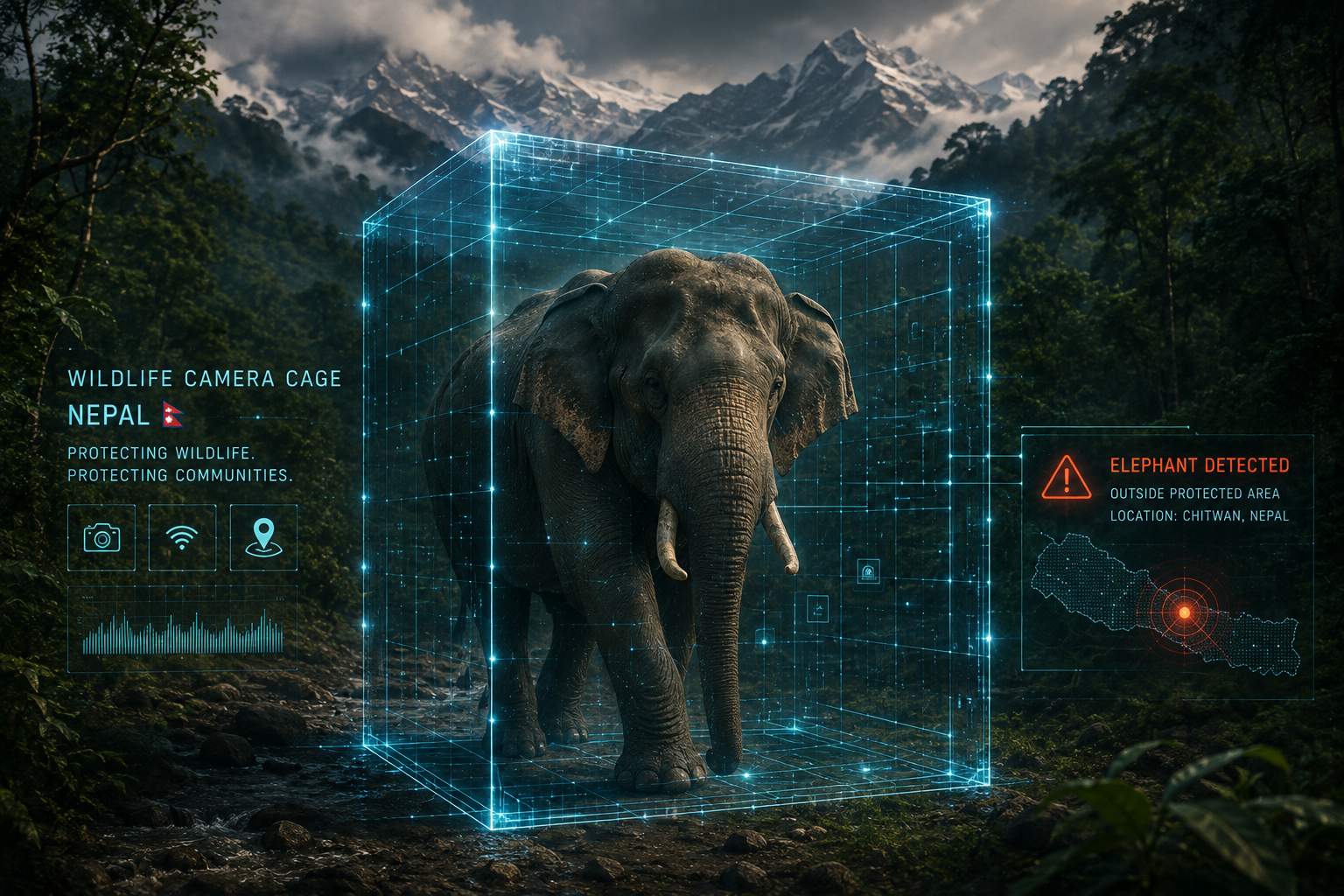
What if we could know an animal had left a protected area before it reached a community?
Protected areas can create boundaries on a map.
Wildlife doesn't necessarily recognize them.
When elephants, tigers, rhinos and other animals move beyond protected areas and toward human settlements, the encounter can become dangerous for both people and animals.
Wildlife Camera Cage explores a simple idea:
What if cameras could create a virtual boundary around wildlife?
Not a physical cage.
A digital one.
The Story So Far
The idea began with a problem in Nepal:
How can communities know when potentially dangerous wildlife has moved outside a protected area?
Wildlife Camera Cage proposes creating a network of cameras around vulnerable boundaries and surrounding communities.
Dedicated wildlife cameras could form part of that network.
But the bigger possibility is connecting them with other participating cameras that may already exist nearby.
When an animal crosses beyond a designated area, artificial intelligence could potentially recognize the species, determine its location and trigger an alert.
The animal remains completely free.
The cage exists only in the digital world.
How Could It Work?
Imagine an elephant moving out of a protected area.
A camera detects movement.
Computer vision identifies an elephant.
Another participating camera detects it farther along its path.
Then another.
Instead of simply recording where the elephant was, the network begins helping us understand where it may be going.
If the system determines that the animal is approaching a community, farm, road or other vulnerable location, an alert could be sent to the appropriate people.
SEE → IDENTIFY → LOCATE → TRACK → ALERT
The goal isn't to control the animal.
It's to give people enough information to respond before an encounter becomes a crisis.
Why a Camera “Cage”?
A traditional cage controls an animal by creating a physical boundary.
Wildlife Camera Cage reverses that idea.
The animal remains free while technology creates a virtual perimeter around its movement.
As cameras detect the animal at different points, those observations could collectively form a kind of digital cage—not preventing movement, but making movement visible.
And unlike a fence, the virtual boundary could potentially change as the animal moves.
The Bigger Possibility
Nepal could provide an important environment in which to investigate the idea, but human-wildlife conflict exists around the world.
If the concept proves workable, similar systems might eventually be adapted for different species and environments.
The larger question is not simply whether we can build another wildlife camera.
It's whether existing and new cameras can cooperate as a network.
Wildlife cameras.
Park cameras.
Road cameras.
Participating civilian cameras.
Other sensors.
Artificial intelligence could potentially connect those observations and turn scattered cameras into an early-warning system.
A camera sees an animal.
A network understands the encounter.
What We Don't Know Yet
This is an unfinished Business Story, and some of the most important questions still need answers.
How accurately can computer vision distinguish individual wildlife species in real-world conditions?
How quickly would alerts need to travel to be useful?
Which cameras and communication networks are already available around protected areas in Nepal?
Could participating civilian cameras contribute without compromising people's privacy?
How should false alarms be handled?
Who should receive an alert?
Park authorities?
Wildlife specialists?
Local communities?
Could predicting an animal's movement create unintended risks, including making wildlife location information available to people who might misuse it?
And most importantly:
Would the system actually make encounters safer for both wildlife and people?
Those aren't problems to hide.
They're questions the Business Story needs answered.
What This Story Needs
This is where CiteShare opens the story.
Maybe you're a wildlife biologist or conservationist who understands animal movement and human-wildlife conflict.
Maybe you live or work in Nepal and understand the realities surrounding protected areas and nearby communities.
Maybe you work with computer vision, AI, trail cameras, telecommunications, mapping or IoT systems.
Maybe you understand privacy, cybersecurity or the risks of sharing wildlife-location data.
Maybe you know of an existing technology or research project that could strengthen—or challenge—the idea.
Maybe you see a flaw we haven't considered.
Maybe you see a better version of the system.
Maybe you know an organization, researcher, park, community or technology company Wildlife Camera Cage should meet.
Add what you know. Challenge what you don't believe. Connect us to what we're missing.
That's Storytelling Serendipity™.