
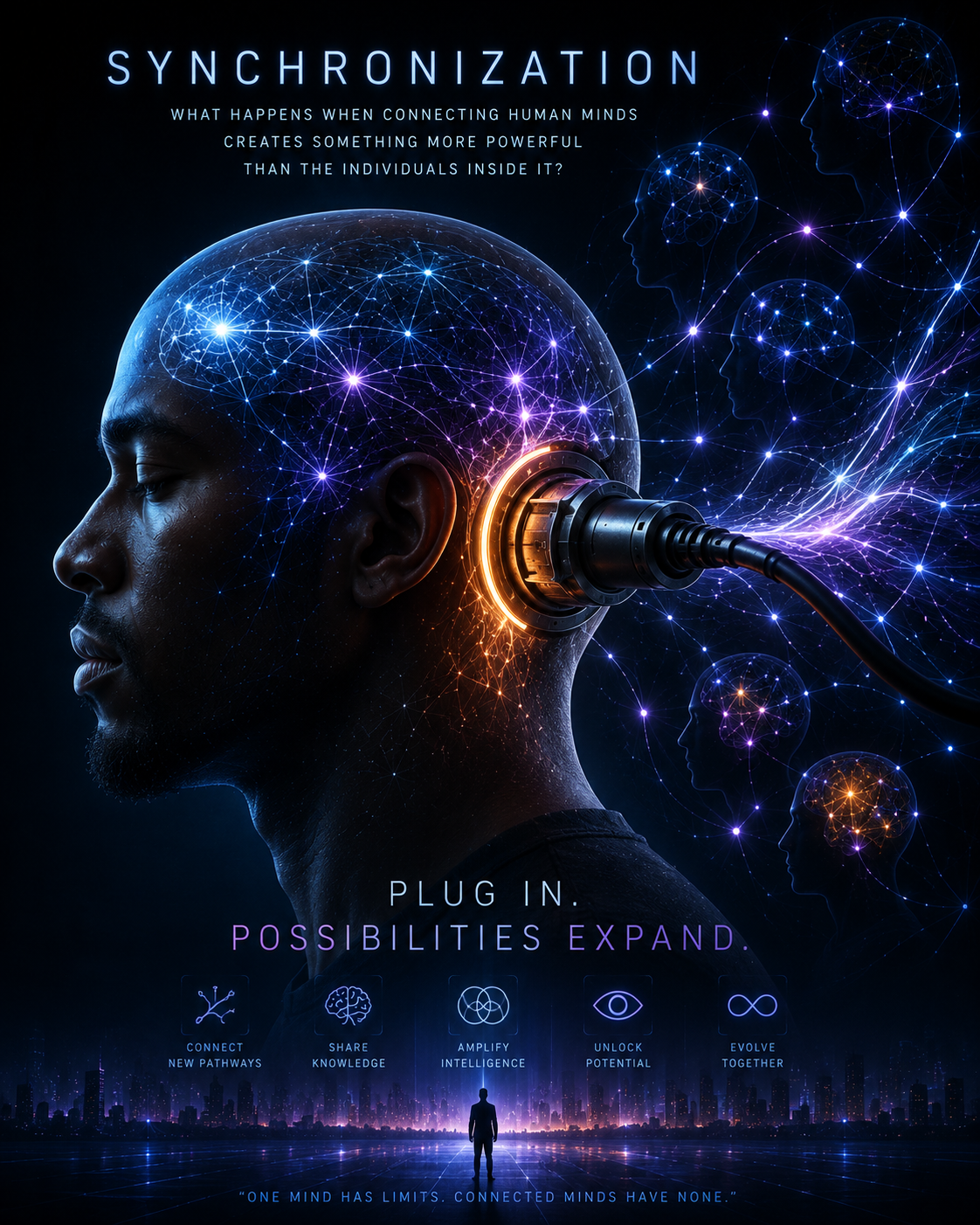
What if connecting human minds created something more powerful than the individuals inside it?
The human brain contains systems that normally operate separately.
We dream. We reason. We remember. We imagine. We fear.
But what if those boundaries aren't limitations?
What if they're safeguards?
Synchronization is a science-fiction story built around an experimental neurological procedure designed to reconnect parts of the human brain in ways nature never intended.
The experiment works.
Just not in the way anyone expected.
The Story So Far
The first subject is Homer, a prisoner with a brain tumor who becomes the unlikely candidate for an experimental procedure.
Researchers believe they are changing the way different regions of his brain communicate.
Instead, they unlock something.
Homer begins experiencing abilities that shouldn't be possible.
Dreams intrude into waking life.
Thought seems capable of affecting the physical world.
The boundary between perception and reality begins to disappear.
And eventually, Homer discovers something even more extraordinary:
another synchronized mind.
When synchronized people encounter one another, their abilities don't simply add together.
They connect.
What Happens When Minds Become a Network?
One computer has power.
Connect millions of computers and you create something fundamentally different.
What if human minds work the same way?
As more people undergo synchronization, individual minds begin functioning as nodes in something larger.
Thoughts can be shared.
Experiences can cross between people.
Abilities can amplify.
A collective consciousness begins to emerge.
Humanity may have accidentally created a biological supercomputer made not from silicon—
but from people.
And Homer, as the first successfully synchronized human, sits at the center of it.
But What Happens to the Individual?
Synchronization promises something humanity has dreamed about for centuries:
Understanding without language.
Knowledge without explanation.
Connection without distance.
But every connection has another side.
If one mind can enter another, where does one person end and another begin?
If millions of people can think together, what happens to disagreement?
Privacy?
Choice?
Individuality?
And what happens to the people who refuse to connect?
Homer begins to realize that the greatest threat may not be what synchronized humanity can do.
It may be what synchronized humanity could become.
The Bigger Possibility
Synchronization begins as science fiction, but its central question reaches directly into the world we're building now.
Human beings are already connecting themselves through increasingly powerful networks, artificial intelligence, brain-computer interfaces and shared digital systems.
Technology keeps reducing the distance between one mind and another.
Synchronization takes that trajectory to its extreme:
What happens when the network is no longer outside us?
What if we become the network?
What This Story Needs
This is where CiteShare opens the story.
Maybe you're a neuroscientist who knows which parts of this premise could be grounded in real brain science.
Maybe you work with brain-computer interfaces, artificial intelligence or neural networks.
Maybe you're a psychologist, philosopher or ethicist who sees consequences we haven't considered.
Maybe you're a filmmaker, producer, screenwriter or visual-effects artist who can imagine how this world should look.
Maybe you see a scientific problem with the premise.
Maybe that problem leads to a better idea.
Maybe you see where Homer's story should go.
Maybe you know someone Synchronization should meet.
Add what you know. Challenge what you don't believe. Connect us to what we're missing.
That's Storytelling Serendipity™.