
The Idea
People have great ideas every day.
An inventor sees a problem nobody else has solved. A songwriter imagines a new kind of entertainment company. A filmmaker develops an extraordinary concept. A community leader sees something their neighborhood desperately needs.
But then comes the harder question:
How do I actually make it happen?
Having the idea and knowing how to build an organization around that idea are two very different skills.
What if artificial intelligence could help bridge that gap?
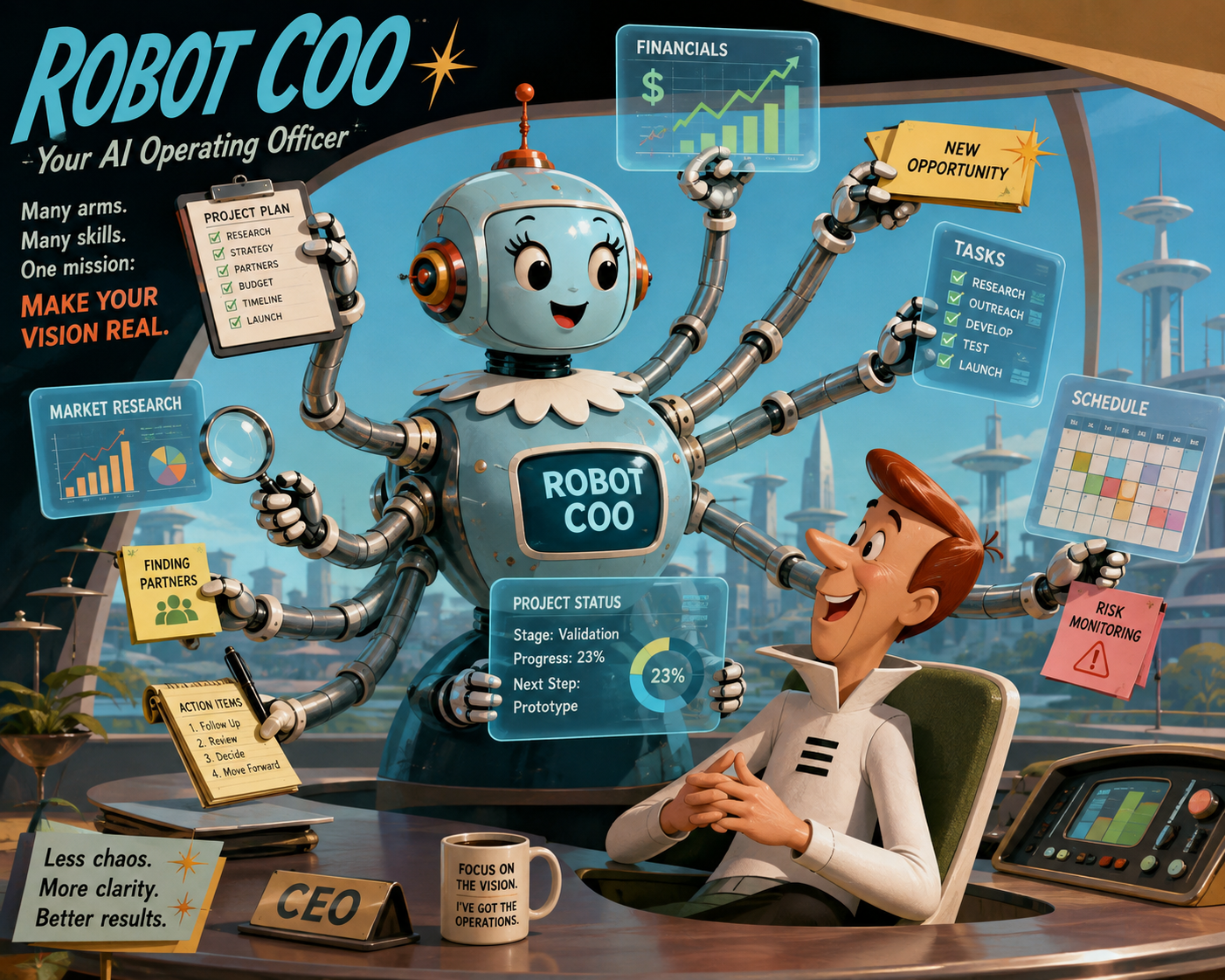
At CiteShare, we're exploring an idea we call Robot COO: an AI-powered operating officer designed to help turn an idea into an executable business or project.
From Idea to Execution
A traditional Chief Operating Officer helps translate a company's vision into operations.
Robot COO would attempt to provide some of that capability much earlier—perhaps even before there is a company to operate.
Imagine submitting a CiteShare project and telling Robot COO:
This is what I want to build.
The system studies the project's story, research, citations, goals, business model and available resources.
Then it begins answering a different question:
What needs to happen next to make this real?
Robot COO could help break the vision into workstreams, identify unanswered questions, conduct research, create project plans, develop budgets, identify potential partners, track milestones, prepare documents and recommend the project's next move.
Instead of simply answering questions when prompted, the long-term goal would be an AI system that keeps helping the project move forward.
An Operating System Before You Have a Company
That may be Robot COO's most interesting possibility.
Most entrepreneurs can't hire a COO when they first have an idea.
They may not even have a company yet.
They have a laptop, a concept and perhaps a few people who believe in it.
What if the idea itself could have an operating officer?
Founder: provides the vision.
CiteShare: develops the business story and supporting evidence.
Robot COO: helps turn that story into coordinated action.
The human founder would remain responsible for consequential decisions, approvals and relationships, while AI handles more of the enormous organizational work between “I have an idea” and “we have a business.”
From Citation to Action
This also raises an intriguing possibility for CiteShare.
A citation doesn't have to end with research.
A piece of evidence can reveal a customer.
Research can uncover a competitor.
A story can attract a collaborator.
A collaborator can provide expertise.
Expertise can change the business plan.
The business plan can produce an action.
So perhaps the CiteShare process becomes:
Story → Citation → Discovery → Connection → Decision → Action → Business
That's where our idea of Storytelling Serendipity becomes especially important.
Robot COO wouldn't simply execute a checklist. It could continually search for the unexpected piece of information, person, technology or connection that changes what the project should do next.
What Could This Become?
Robot COO could eventually be joined by other specialized AI executives: an AI CFO for financial modeling, an AI CMO for marketing, AI researchers for evidence and competitive intelligence, and AI project managers for deadlines and deliverables.
Instead of requiring an entrepreneur to assemble an entire executive organization before an idea has proven itself, perhaps AI can provide some of that organizational intelligence from the beginning.
We're not suggesting that today's AI should be handed unrestricted control of a company.
We're asking a different question:
How much of the work of building a company can an AI operating officer responsibly take on?
And an even bigger one:
What happens when having a great idea no longer requires already knowing how to build a company?
That's the experiment behind Robot COO.
CiteShare is where stories become businesses.
Maybe Robot COO can help them get there.
Explore this story.